Research
My research concerns the mathematical modeling, analysis, and control of dynamical systems. I am particularly interested in how mathematical representations reveal the structures governing system behavior and how these structures can be exploited for prediction and control.
Three closely connected themes run through my work.
Nonlinear dynamics and geometric methods
Geometric structures, particularly invariant manifolds, provide insight into the behavior of nonlinear dynamical systems.
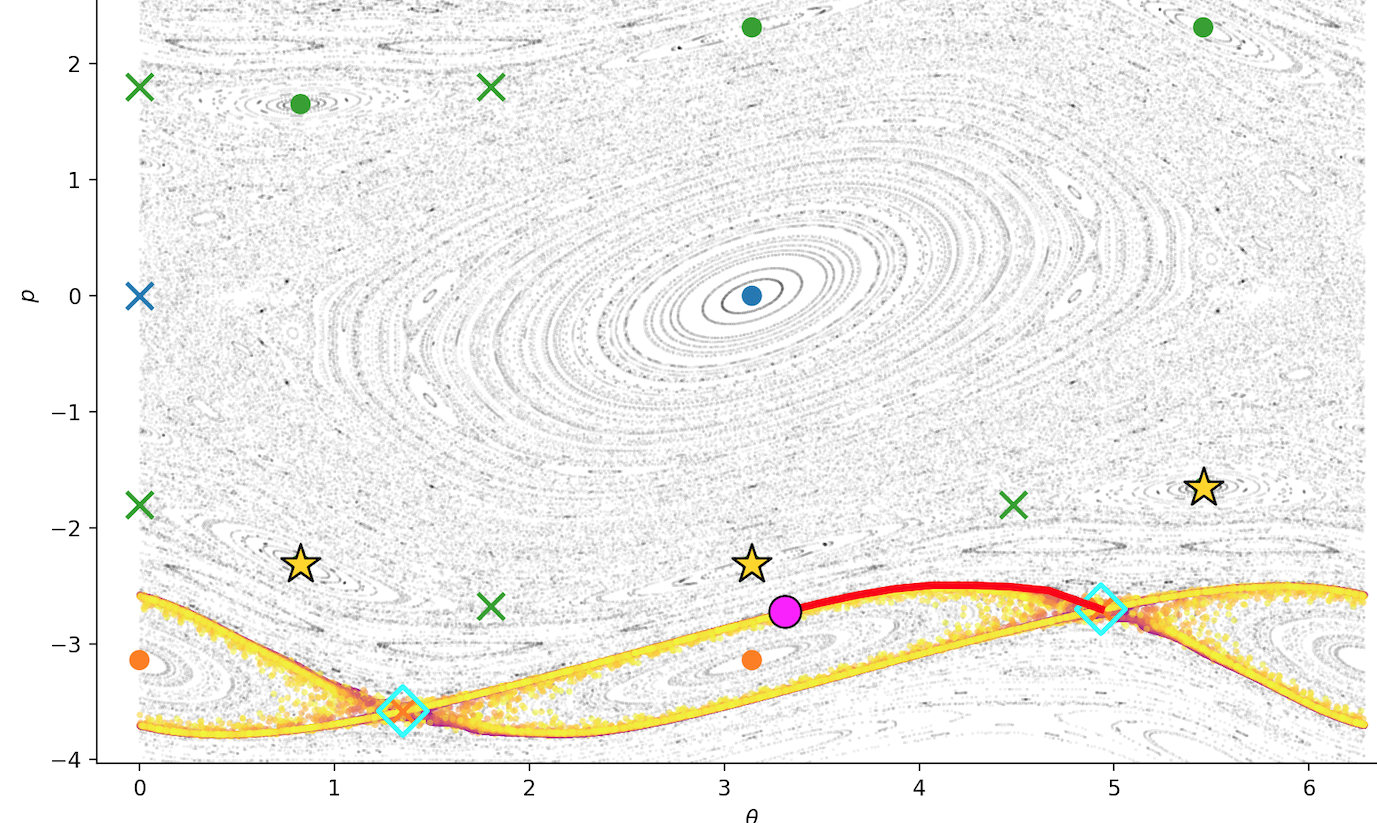
My current research investigates how invariant structures can be used to understand and control transport in nonlinear dynamical systems, with applications in astrodynamics. In collaboration with Prof. Shane D. Ross at Virginia Tech, this work includes hybrid control methods for transfers between invariant structures and the classification of chaotic trajectories in cislunar space.
Recent conference contributions include Hybrid MPC–OGY Control for Transport Between Invariant Structures with Application to Keplerian Maps (D. M. Luchtenburg and S. D. Ross) and Dynamical Classification of Chaotic Cislunar Trajectories via Resonance Structure (A. M. Lutz, D. M. Luchtenburg, A. Rawat, and S. D. Ross).
Modeling and prediction of dynamical systems
Complex dynamical systems often admit lower-dimensional representations that capture their essential behavior.
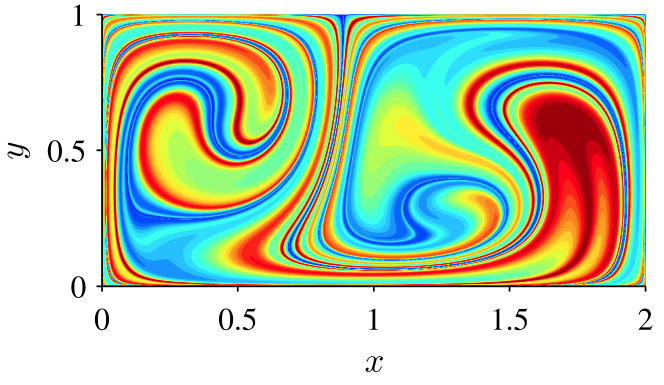
My contributions include reduced-order modeling of fluid flows, proper orthogonal decomposition, dynamic mode decomposition, and methods for long-time uncertainty propagation. Representative publications include On dynamic mode decomposition: Theory and applications and Long-time uncertainty propagation using generalized polynomial chaos and flow map composition.
Control of dynamical systems
Mathematical modeling and dynamical systems theory provide the foundation for understanding and controlling physical systems.
My work combines theoretical and computational methods with experimental investigations, including ship stabilization, robotic systems, autonomous vehicles, and student-led research projects. An example is Seven Degrees-of-Freedom Model for the Roll Stabilization of Unstable Ships.
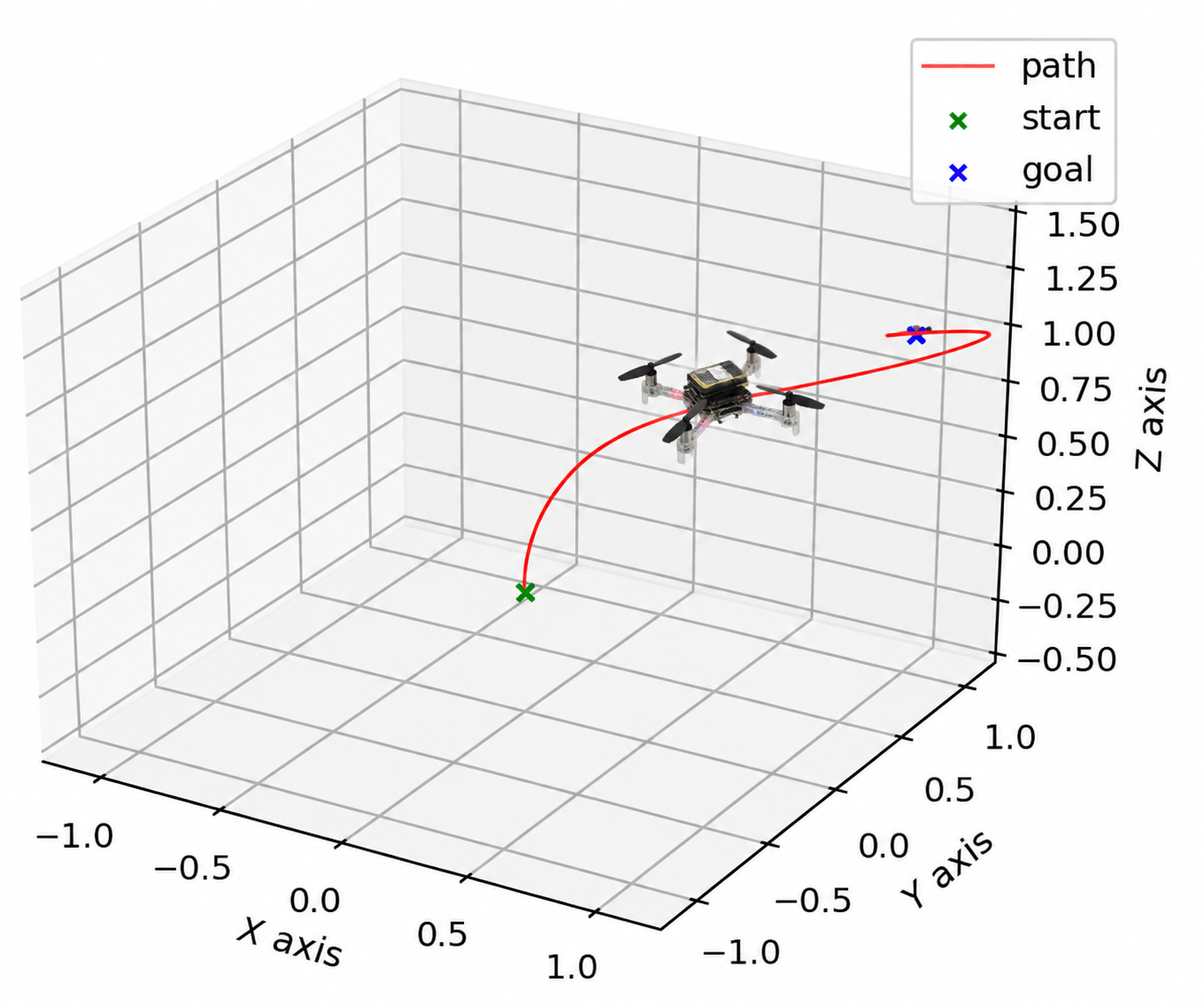
Research at The Cooper Union involves undergraduate and master’s students in mathematical modeling, computation, simulation, and experimental investigation.